At first
Introduction of 5G technology and its expectations
Hi all. 5G, which launched commercial services in Japan in March 2020, is said to bring major changes to our lives. However, in reality, there are still not many people who feel the change in their daily lives. 5G is an abbreviation for fifth-generation mobile communication system, which is characterized by ultra-high-bandwidth transmission using a higher frequency band than conventional 4G. This is expected to benefit from high-speed communication, large data transfers, and low latency.
Overview of 5G penetration in Japan
However, few people are aware of the fact that there are actually two types of 5G currently used in Japan. These are called "sub-6" and "millimeter wave", and they each use different frequency bands. Currently, sub-6 is mainly used in smartphones. This has the advantage that 4G technology can be repurposed, and the usage environment is set up relatively quickly. On the other hand, mmWave 5G is currently being developed, which is also called "true 5G". Millimeter-wave 5G is expected to be an overwhelming technological innovation, and it is said that it will greatly surpass sub-6 in terms of high speed, large capacity, and low latency.
Explanation of 5G technology
Basic concepts and features of 5G
5G, or fifth-generation mobile communication systems, is a significantly more advanced communication technology than traditional 4G/LTE. The main feature is ultra-high-bandwidth transmission by using high frequency bands. This makes it possible to transfer large amounts of data at high speeds, which greatly improves the quality of video calls, for example, and allows us to enjoy technologies such as VR and AR in more real-time.
Differences and characteristics between "sub-6" and "millimeter wave"
There are two main types of 5G: sub-6 and millimeter wave. As the name suggests, sub-6 uses the sub-6 GHz frequency band, which has the advantage of making it easier to repurpose some of the 4G technology. In contrast, millimeter waves use a higher frequency band of 28 GHz to 300 GHz. Millimeter waves are capable of high-speed, large-capacity data transmission due to their high frequency characteristics, but on the other hand, they also have short transmission distances and are vulnerable to obstacles.
Understanding these differences is critical to understanding 5G technology as a whole. Sub-6 is relatively easy to adapt to existing infrastructure and is expected to be widely used soon, but mmWave is more technologically advanced and has a high potential for the future.
The potential of millimeter waves, called "true 5G"
Technical Benefits of mmWave 5G
Millimeter-wave 5G has a performance that sets it apart from conventional wireless communication technologies due to its high-frequency band characteristics. This mmWave uses the range of 28 GHz to 300 GHz, which allows for very fast and large data transmission. For example, it is expected to enable advanced applications that were previously difficult to solve, such as streaming 4K and 8K high-definition video, improving VR and AR experiences, and real-time communication in self-driving cars.
Increased speed and connectivity
The biggest advantage of mmWave 5G is the dramatic increase in its communication speed. In theory, millimeter waves can transfer data much faster than sub-6s, which is expected to significantly change the Internet experience. In addition, it is resistant to a large number of connections in high-density areas, and is expected to improve communication quality at large-scale events and urban areas.
However, due to the short transmission distance of millimeter waves and their vulnerability to obstacles, special consideration is required for infrastructure development. Specifically, more base stations will be required, which is an important factor that will also impact urban landscapes and costs.
Military use of 5G technology
Military technology "ADS ADS" using millimeter waves
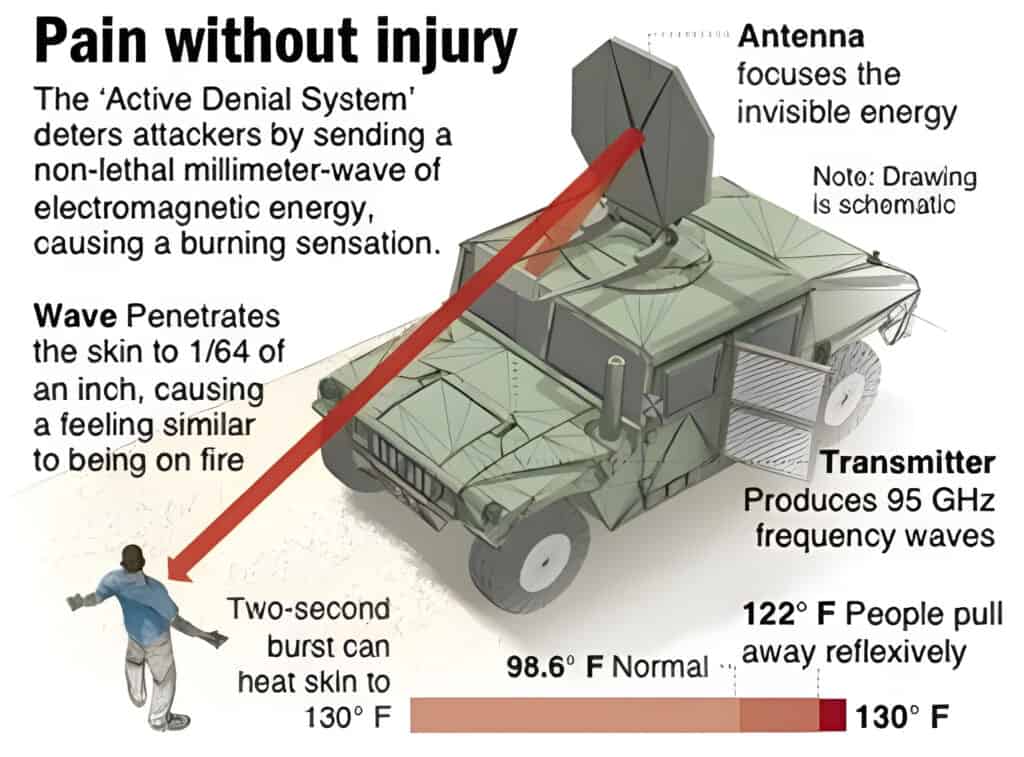
Millimeter-wave 5G technology is also attracting attention in the military field due to its characteristics. In particular, in the United States, the development of a non-lethal weapon using millimeter waves called "Active Dynial System (ADS)" is underway. This weapon is intended to be used for the purpose of controlling people by giving the irradiated subject a sensation like a burn. This technology, which uses the effects of millimeter waves on the human body, shows a different direction from peaceful use and is the subject of social debate.
Discussion on the military application of electromagnetic waves
The debate over the military use of mmWave 5G presents a completely different aspect to the civilian use of the technology. The presence of electromagnetic weapons may also affect the public's perception of 5G technology. Rather, it is thought that this is the purpose of the development of millimeter-wave 5G. How many people know this fact? I must say that a deeper discussion is needed.
Conclusion and Discussion
Balancing the benefits and risks of 5G technology
5G technology, especially millimeter wave, has enormous potential. It enables high-speed, high-capacity data transmission and is expected to revolutionize our lives and industries. However, at the same time, there are risks associated with these technologies, such as their effects on the human body, concerns about their military use, and so on. How to balance these benefits and risks will be an important debate as the technology becomes more widespread.
The Social Impact of Capitalism and Technological Innovation
The evolution of 5G technology lies at the intersection of capitalism and technological innovation. The pursuit of economic growth and efficiency is often the main motivation for technological development, but we must not forget the social and ethical issues that come with it. How we should perceive and respond to the potential risks posed by excessive technological progress will be a major challenge in the future.
How did you feel about the potential and risks of 5G technology, especially mmWave? We'd love to hear your thoughts and opinions on the changes this technology will bring.